
The Riot Squad – David Bowie’s Transitional 1967 Band
The Riot Squad were a London pop-rock group with whom David Bowie briefly performed and recorded in the spring of 1967. Although Bowie’s time with the band was short, it came at a crucial moment between his final pre-fame group work and the beginning of his more distinct solo identity.
Bowie did not found The Riot Squad, nor was he a long-term member. Instead, he joined one particular 1967 line-up for a brief run of live performances and studio recordings, many of which remained unreleased at the time and only surfaced decades later.
- Band active overall: from 1964
- Bowie’s period: spring 1967
- Genre: pop, rock, mod / psychedelic transition
- Bowie’s role: vocals, guitar, harmonica
- Significance: a brief but revealing bridge between Bowie’s band years and solo work
Background and formation
The Riot Squad existed before David Bowie joined them. The group first emerged in 1964 and went through numerous personnel changes, with Bob Evans remaining the one key continuing figure through different incarnations. By the time Bowie became involved, the band had already passed through earlier line-ups and recording phases.
This makes The Riot Squad different from Bowie’s earlier groups such as The King Bees, The Manish Boys, or The Lower Third. In this case, Bowie stepped into an already existing band rather than forming a new one around himself.
Bowie’s role in the band
Bowie joined a 1967 Riot Squad line-up while he was also working on material connected to his debut solo album period. His time with the group appears to have been partly practical and partly experimental: it gave him another live outlet, while also allowing him to test songs and ideas that were moving beyond straightforward R&B.
In the Bowie-era Riot Squad line-up, he is most consistently documented as performing lead vocals, as well as guitar and harmonica.
Band members
The best-documented Bowie-era line-up of The Riot Squad consisted of:
David Bowie – vocals, guitar, harmonica
Rod “Rook” Davies – guitar
Brian “Croak” Prebble – bass, vocals
Bob Evans – saxophone, flute, vocals
George Butcher – keyboards
Derek “Del” Roll – drums
Earlier and later Riot Squad line-ups included many other musicians, but this is the line-up most clearly associated with Bowie’s brief 1967 involvement.
Recordings with Bowie
During Bowie’s stint with The Riot Squad, the band recorded several tracks that were not officially released at the time. Among the best-known are a version of “I’m Waiting for the Man”, Bowie’s “Toy Soldier” (sometimes listed as “Little Toy Soldier”), and versions of “Silly Boy Blue”.
These recordings are historically important because they show Bowie engaging very early with Velvet Underground material and experimenting with darker, more provocative songwriting ideas. However, they should be understood as archival material rather than contemporary official releases.
Posthumous releases
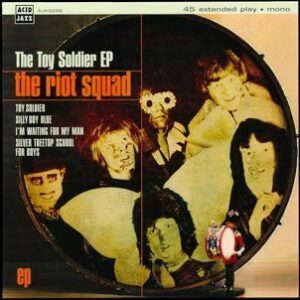
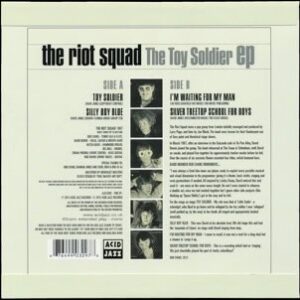
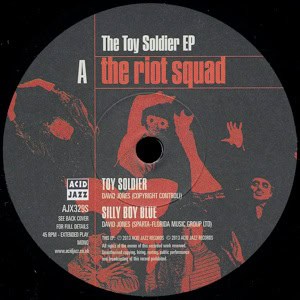
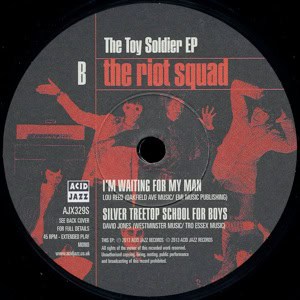
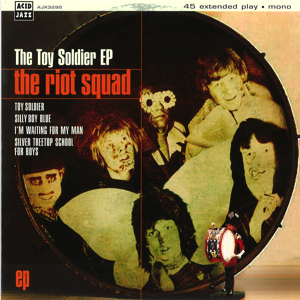
Recordings made by David Bowie with The Riot Squad in 1967 were not released at the time. These sessions remained unheard for decades and only surfaced later through archival releases.
In 2013, material from these recordings was officially issued on releases such as The Toy Soldier, making the Bowie-era Riot Squad sessions widely available for the first time.
These recordings include early versions of songs such as “Toy Soldier” (also known as “Little Toy Soldier”), “Silly Boy Blue”, and a cover of “I’m Waiting for the Man”, highlighting Bowie’s growing interest in more experimental and avant-garde influences.
Live performances and style
Bowie’s brief period with The Riot Squad appears to have made the band more theatrical and more adventurous on stage. Accounts from participants describe a shift away from a standard club-band presentation toward something more visual and concept-driven, with Bowie contributing ideas about image, staging and repertoire.
This is one reason the Riot Squad period matters. Even in a short-lived setting, it hints at the instinct for transformation and presentation that would soon become central to Bowie’s career.
Departure
Bowie’s involvement with The Riot Squad lasted only a short time in the spring of 1967. After that, he moved fully back toward his solo path, while the band continued in other forms without him.
The short duration of this collaboration is important: The Riot Squad were not Bowie’s breakthrough band, but rather a final, transitional group experience before his artistic identity became more distinct and self-directed.
Place in Bowie’s development
In retrospect, Bowie’s time with The Riot Squad occupies a small but fascinating place in his story. It belongs to the unstable, experimental period between his mod-era records and the clearer emergence of the songwriter and conceptual performer who would define the next stage of his career.
Their legacy lies less in chart success than in the surviving recordings and eyewitness accounts, which show Bowie already reaching toward the more theatrical, transgressive and forward-looking work that would soon follow.

Video: Little Toy Soldier

Video: Silly Boy Blue

Video: I’m Waiting For The Man

Video: Silver Treetop School for Boys
-
Video: Little Toy Soldier
BOWIE ~ RIOT SQUAD ~ LITTLE TOY SOLDIER -
Video: Silly Boy Blue
David Bowie The Riot Squad - Silly Boy Blue (demo 1967) -
Video: I’m Waiting For The Man
David Bowie & The Riot Squad - I’m Waiting For The Man (1967 Version / 2025 Stereo Mix) (Visualiser) -
Video: Silver Treetop School for Boys
The Riot Squad - Silver Treetop School for Boys
The Riot Squad Era
🏛️ The Swan
🎤 Artist: The Riot Squad
🗒️ Notes: Intensive rehearsals begin. David introduces theatrical elements and mime into the band’s gritty R&B set.
🏛️ Woodlands Youth Centre
🎤 Artist: The Riot Squad
🗒️ Notes: Live performance showcasing the band’s high-energy soul and mod set.
🏛️ Kodak’s Social Club, Eastman Hall
🎤 Artist: The Riot Squad
🗒️ Notes: A performance for the local social club scene.
🏛️ Decca Studios
🎧 Event: Recording: ‘I’m Waiting For The Man’
🎤 Artist: The Riot Squad
🗒️ Notes: David leads the band in recording one of the earliest known covers of the Velvet Underground.
🏛️ Tiles Club
🎤 Artist: The Riot Squad
🗒️ Notes: Performance at the famous underground mod club.
🏛️ Bossard Hall
🎤 Artist: The Riot Squad
🗒️ Notes: One of the final documented live shows with the band before David focuses on his solo debut.