
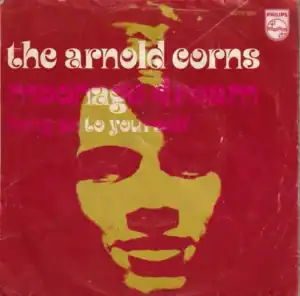
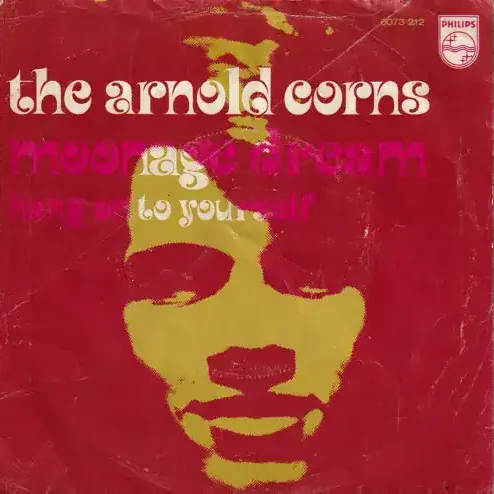
Arnold Corns Moonage Daydream - Hang On To Yourself (1971 Netherlands) estimated value € 800,00
Label: Philips – 6073 212
Format: Vinyl, 7", 45 RPM, Single
Released: 1971
Country: Netherlands
Note 1: Dutch issue with misprint: "Moonage Dream" on sleeve and label. Interesting since Arnold Corns was used to move away from the Philips/Mercury label.
Note 2: A B&C Recording.
Arnold Corns was a short-lived musical project fronted by David Bowie in 1971, primarily to release early versions of songs like "Moonage Daydream" and "Hang On to Yourself" before they became famous on the Ziggy Stardust album, featuring different musicians and a less polished sound, with the band's aesthetic also influencing the iconic Ziggy Stardust look.
- The Project: Bowie using a band with other members like Mark Carr-Pritchard to get songs heard.
- "Moonage Daydream" Release: Released in 1971 with "Hang On to Yourself" as B-side; gained little traction.
- Ziggy Stardust Connection: Tracks were re-recorded for the Ziggy Stardust album (1972).
- Visuals: Designed by Freddie Burretti, shaping Ziggy’s look.
- Sound: Simpler, less bombastic than Ziggy versions.
In essence, Arnold Corns was a precursor, a test run that allowed Bowie to develop and eventually unleash "Moonage Daydream" and its companions in their definitive form.
Tracklist
Side A – Moonage Daydream
Side B – Hang On To Yourself
Media & Sleeve Condition
Media: Very Good Plus (VG+)
Sleeve: Very Good Plus (VG+)
Ring wear: Yes
All seams perfect: Yes
Picture sleeve near mint: No
Creases/folds: Yes
Stamps or writing: Yes
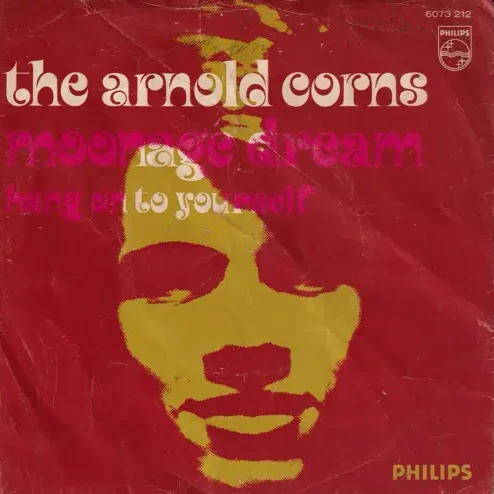
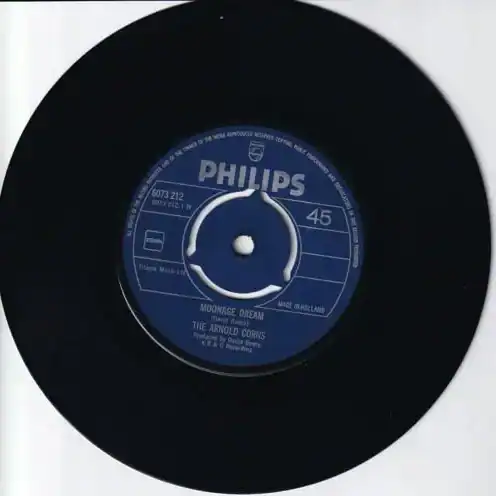
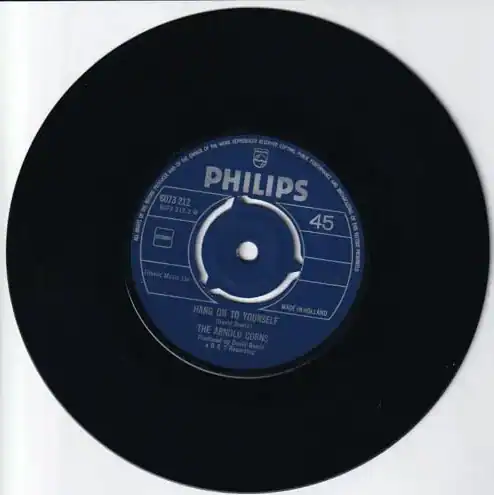
David Bowie & Arnold Corns – The Prototype of Ziggy Stardust (1971–1972)
Arnold Corns occupies one of the most fascinating and misunderstood positions in David Bowie’s artistic evolution. Active briefly between 1971 and 1972, Arnold Corns was not a conventional band, but a deliberate experimental construction — a rehearsal space for ideas, identities, and sonic attitudes that would soon crystallize into Ziggy Stardust.
Rather than existing as a stable musical entity, Arnold Corns functioned as a conceptual prototype: an early embodiment of Bowie’s emerging alien rock-star mythology, filtered through glam theatrics, science-fiction narrative, and exaggerated gender ambiguity.
The Origin of Arnold Corns
The project was formed in early 1971, initiated by Bowie and manager Tony Defries. The name itself — Arnold Corns — was intentionally absurd, artificial, and performative. It was never intended to feel organic or authentic.
Bowie was deeply interested in the idea of manufactured identity: characters that appeared real on the surface but were fundamentally fictional constructs. Arnold Corns allowed him to explore this concept publicly without placing his own name at the center.
A Vehicle for Glam Experimentation
Musically, Arnold Corns served as a testing ground for a heavier, more theatrical sound that marked a decisive break from Bowie’s folk-oriented and introspective earlier work. The project leaned toward raw rock energy, exaggerated vocals, and stylized aggression.
The songs associated with Arnold Corns — including early versions of “Moonage Daydream” and “Hang On to Yourself” — were not final statements. They were sketches, distortions, and provocations.
Freddie Burretti – The Visible Frontman
One of the most radical aspects of Arnold Corns was Bowie’s decision to remain largely offstage. Instead, the project placed Freddie Burretti in the role of lead vocalist and visual focal point.
Burretti, with his flamboyant appearance, exaggerated sexuality, and raw delivery, embodied many of the qualities Bowie was exploring — but from a distance. Bowie observed, adjusted, and refined the concept through Burretti’s performance.
Identity as Performance
Arnold Corns was not simply a musical experiment — it was a live demonstration of Bowie’s growing belief that identity itself could be staged, worn, discarded, and redesigned.
The project challenged the assumption that a band must be “real” in a traditional sense. Instead, it embraced artificiality as an aesthetic and philosophical tool.
The Relationship to Ziggy Stardust
The connection between Arnold Corns and Ziggy Stardust is direct and undeniable. Many musical elements, lyrical fragments, and visual attitudes developed within Arnold Corns were later refined and perfected in Bowie’s most iconic persona.
What Arnold Corns lacked in coherence, Ziggy Stardust would gain in narrative focus. What Arnold Corns exaggerated, Ziggy would mythologize.
Why Arnold Corns Failed — and Why That Mattered
Arnold Corns was short-lived and commercially unsuccessful. The project confused audiences, record labels, and even musicians involved. Its artificial nature resisted easy marketing.
But this failure was not accidental — it was instructive. Bowie learned what worked, what alienated, and what needed refinement before launching Ziggy Stardust under his own name.
The Psychological Distance Strategy
By stepping back from the spotlight, Bowie gained a rare opportunity: he could observe the reaction to glam theatricality without fully inhabiting it himself.
This psychological distance allowed Bowie to fine-tune the balance between provocation and empathy — a balance that would define his greatest work.
Arnold Corns as Conceptual Art
In retrospect, Arnold Corns resembles a piece of conceptual performance art more than a band. Its existence questions authorship, authenticity, and the boundaries between artist and persona.
Bowie was not merely writing songs — he was constructing frameworks through which identity could be examined and reimagined.
Legacy and Reassessment
Though rarely discussed outside specialist circles, Arnold Corns holds enormous historical value. It represents the moment where Bowie consciously crossed from singer-songwriter into architect of myth.
Without Arnold Corns, Ziggy Stardust would not exist in the form we recognize today. The project’s awkwardness, exaggeration, and failure were essential components of Bowie’s evolution.
Arnold Corns in Bowie’s Broader Narrative
Arnold Corns stands as proof that Bowie’s reinventions were not spontaneous acts of genius, but the result of rigorous experimentation, risk-taking, and deliberate missteps.
It is one of the clearest examples of Bowie using the world itself as a laboratory for ideas — testing identity in public before committing it to history.
Cultural Legacy
Today, Arnold Corns is best understood not as a footnote, but as a missing chapter — the prototype phase of one of the most influential personas in popular music history.
It reminds us that Bowie’s genius lay not only in success, but in his willingness to fail spectacularly in pursuit of transformation.